Mountain Gorilla Conservation in Rwanda: 2026 Status
Mountain gorillas remain Endangered, but their wild population has recovered to an estimated 1,063 individuals. Rwanda’s conservation model combines intensive monitoring, veterinary care, protected-area management, community partnerships and carefully managed tourism.
Last reviewed August 2026. Conservation data changes — see the cited sources for the latest figures.
Why mountain gorilla conservation matters in Rwanda
In Rwanda, mountain gorilla conservation is concentrated in the Virunga Mountains, where the species shares a border-spanning forest ecosystem with Uganda and the Democratic Republic of the Congo. Rwanda’s principal gorilla habitat is Volcanoes National Park, part of a connected network of parks that forms the mountain gorillas’ only home.
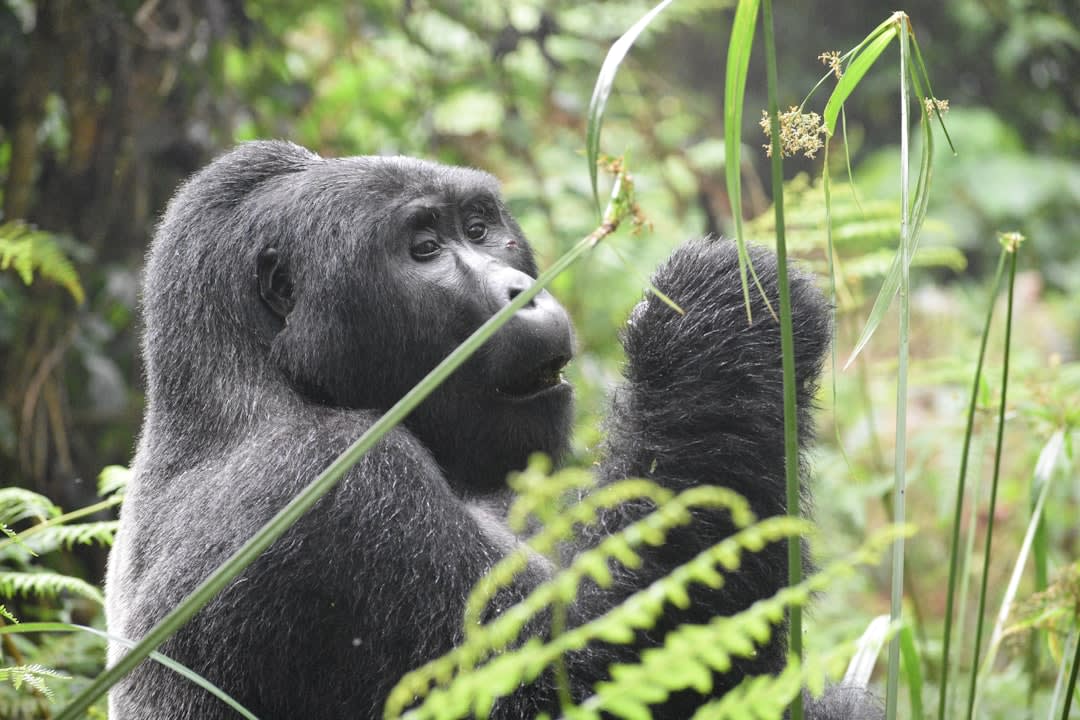
Mountain gorillas are one of two subspecies of eastern gorilla. Their thick, dark fur helps them withstand the cold and persistent rain of high-altitude afromontane forests. The subspecies is especially vulnerable because its entire range is small, fragmented by international borders and surrounded by densely settled agricultural landscapes.
The conservation story is also inseparable from Rwanda’s modern history. Poaching, habitat clearance, disease, civil conflict and regional unrest placed the gorillas under sustained pressure for decades. The 1994 Rwandan genocide and subsequent conflict in the wider region disrupted communities and conservation institutions, while park landscapes in the Virunga region became vulnerable to armed groups and displacement.
Yet the population has increased rather than continued to decline. The International Gorilla Conservation Programme (IGCP), a coalition involving Fauna & Flora International and WWF, says the subspecies moved from Critically Endangered to Endangered following an IUCN Red List review in 2018. That change reflects recovery, not security: mountain gorillas still require daily protection and active habitat management.
The main threats to Rwanda’s mountain gorillas
Poaching and snares
Mountain gorillas are not usually the intended target of wire and rope snares, which are set for other wildlife, but the traps can maim or kill them. Infants and curious young gorillas are particularly vulnerable when they encounter devices on the forest floor. Conservation teams therefore combine patrols, monitoring and snare removal rather than treating poaching only as a direct hunt for gorillas.
Historical poaching also included the capture of infants for illegal sale, an activity that could result in adult gorillas being killed during the removal of a young animal. The risk is compounded by the small size of the total population: the loss of even one breeding adult can have consequences for a group and for the subspecies as a whole.
Habitat loss and limited range
Habitat loss is the primary long-term threat identified by IGCP. Forest clearance for agriculture, pressure on firewood and other natural resources, settlement expansion and illicit charcoal production can reduce or degrade the limited afromontane habitat available to gorillas.
Rwanda faces a difficult land-use challenge. The country’s expanding gorilla population needs more forest, while neighbouring communities need secure access to land, energy, jobs and livelihoods. The African Wildlife Foundation describes this as a central conservation question: how to restore Volcanoes National Park and create community resilience around it without shifting costs unfairly onto local households.
Rwanda has begun planning and implementing a major expansion of Volcanoes National Park. Research supplied for this article describes the Volcanoes Community Resilience Project as a World Bank-backed initiative intended to expand the park by 23%, while other reporting describes a proposed addition of approximately 37.4 square kilometres, or nearly 25% of the protected area. These figures refer to the expansion plan rather than additional gorilla numbers already achieved, and implementation should be checked against the latest official updates.
Disease and human-wildlife health risks
Respiratory disease is a persistent concern because mountain gorillas are closely related to humans and can be exposed to pathogens carried by people. UNESCO identifies disease transmission from humans as one of the major historical threats, while conservation teams use veterinary attention and treatment of respiratory illness as part of routine protection.
A 2026 study of endangered wild mountain gorillas in Rwanda examined 346 individuals in 21 family groups. The study was designed to investigate environmental and demographic risk factors for respiratory illness; its sample should not be mistaken for the entire global mountain gorilla population.
The health risk runs in both directions. Responsible tourism therefore requires visitors to follow park health rules, keep their distance, avoid visiting when ill and comply with guidance from trackers and park authorities. These precautions protect habituated gorillas from avoidable human disease exposure while also making encounters safer and less disruptive.
Climate change and changing forest conditions
Climate change is an emerging pressure alongside habitat loss, disease and snares. Changes in rainfall and temperature can affect forest conditions, plant availability and the agricultural stability of communities living beside the park. Because mountain gorillas occupy a restricted high-altitude range, they have limited scope to move into entirely new habitats if conditions change.
Conflict and insecurity
Regional conflict has historically affected the Virunga landscape, creating risks for wildlife, communities and the people who patrol protected areas. IGCP reports that more than 100 rangers have died protecting the wider park system over the years. This is a reminder that conservation gains have involved substantial human risk as well as scientific and financial investment.
What is being done to protect mountain gorillas in Rwanda?
Daily monitoring and ranger protection
Mountain gorilla conservation relies on unusually intensive field protection. Rangers and trackers monitor groups, record births and deaths, follow movements, remove snares and identify signs of illness or injury. Across the Virunga landscape, more than 1,000 park rangers have supported close daily monitoring over four decades, including during periods of violent conflict.
Monitoring also produces the evidence needed to make management decisions. The mountain gorilla censuses have been led by the governments of Rwanda, Uganda and the DRC, with support from organisations including IGCP, the Dian Fossey Gorilla Fund, the Max Planck Institute for Evolutionary Anthropology, Gorilla Doctors, the Institute of Tropical Forest Conservation and North Carolina Zoo.
The Dian Fossey Gorilla Fund’s Rwanda programme and Karisoke Research Center are important examples of long-term scientific and field involvement. Felix Ndagijimana, director of Rwanda programs and Karisoke Research Center, has credited collaboration among governments, conservation organisations and other partners as a major reason for the census and broader conservation effort.
Veterinary care and One Health approaches
Veterinary teams provide treatment and health surveillance for gorillas, including respiratory disease management. Removing snares is also a veterinary intervention when animals are found injured or trapped. The Gorilla Doctors are among the specialist partners involved in the wider census and conservation network.
The 2026 respiratory-illness research adds a more detailed scientific basis for prevention. By examining group size and environmental and demographic factors, researchers can help conservation managers identify where illness risk may be higher and target monitoring accordingly.
Cross-border collaboration
No single country can conserve mountain gorillas in isolation. The population is distributed across a transboundary network of parks in Rwanda, Uganda and the DRC, so conservation organisations work with national authorities and local institutions at both population and landscape levels.
IGCP’s work includes supporting ranger training, park-management capacity, cross-border collaboration and tourism revenue-sharing mechanisms involving communities near the parks. The programme’s stated achievements include stronger social and political support for conservation and improved effectiveness in managing mountain gorilla parks.
Protected-area restoration
Habitat restoration is becoming as important as patrols. The African Wildlife Foundation reports that it donated 27.8 hectares to the Rwandan government in 2018 for addition to Volcanoes National Park, describing it as the park’s first expansion in 30 years. Its current Rwanda programme focuses on restoring the park while supporting community livelihoods and resilience.
Proposed larger-scale expansion of Volcanoes National Park aims to provide more space as the population grows and to reduce pressure arising from interactions between gorilla groups and nearby communities. However, expansion is not a standalone solution: it must be paired with fair land-use planning, livelihood support, effective enforcement and long-term community participation.
Community conservation and tourism’s role
Tourism can help align the economic value of protected forests with the interests of people living around them. IGCP reports that collaboration across Rwanda, Uganda and the DRC has improved tourism revenue-sharing among park-adjacent communities. The African Wildlife Foundation likewise describes Rwanda’s gorilla tourism model as economically important while emphasising the need to diversify opportunity and strengthen resilience for surrounding communities.
Gorilla trekking is not simply a wildlife encounter; it is part of a wider conservation economy involving guides, trackers, porters, accommodation providers, transport operators and local businesses. The strongest model is one in which tourism supports protection and creates credible benefits for communities, while visitor numbers and behaviour remain compatible with gorilla health and welfare.
Tourism also has limits. It cannot replace public conservation funding, ranger protection or habitat planning, and income can be vulnerable to disease outbreaks, insecurity and economic shocks. Community benefits must be transparent and sustained rather than assumed merely because visitors pay for a permit or stay near the park.
SafariFind travellers can book conservation-supporting safaris through the marketplace, while choosing operators that explain how they follow park rules, employ local people and contribute responsibly to the places they visit.
Results and setbacks: a fragile conservation success
The clearest result is the recovery from fewer than 400 mountain gorillas believed to remain worldwide in the 1980s to an estimated 1,063 in the wild at the last count. The Virunga Massif population alone reached 604 individuals, compared with 480 in 2010, according to WWF.
| Indicator | Reported finding | Source and context |
|---|---|---|
| Global wild population | Estimated 1,063 individuals | Last count reported by Fauna & Flora International; the subspecies remains Endangered. |
| Virunga Massif population | 604 individuals, up from 480 in 2010 | WWF summary of population findings. |
| Historical baseline | Fewer than 400 worldwide in the 1980s | IGCP account of the conservation context. |
| Rwanda respiratory-illness study | 346 gorillas across 21 family groups | Research sample, not a total population estimate. |
The recovery led to the 2018 IUCN status change from Critically Endangered to Endangered, a significant milestone for conservation. It does not mean that mountain gorillas are safe: their habitat remains limited, the population remains small, and Dr Tara Stoinski of the Dian Fossey Gorilla Fund has warned that disease, human pressure, climate change and other threats could quickly reverse progress.
There are also ecological and social setbacks associated with success. As gorilla numbers increase and groups use more of the available habitat, interactions between gorilla families can intensify, sometimes resulting in the death of young gorillas. Greater contact between gorillas and neighbouring communities is another management challenge, reinforcing the need for habitat expansion and community-based planning.
How travellers can help responsibly
- Follow health guidance. Do not trek when ill, and follow all instructions on masks, distancing and contact with gorillas. Human respiratory disease is a documented conservation concern.
- Keep the required distance. Do not approach, touch, feed or attempt to attract a gorilla. Let trackers manage the encounter and keep voices low.
- Never leave the trail. Staying with the group reduces disturbance and helps protect fragile forest habitat.
- Choose locally connected services. Use licensed operators and consider local guides, porters, accommodation and community enterprises so tourism benefits are distributed around the destination. Community revenue-sharing is part of the wider conservation model.
- Respect photography rules. Avoid flash and follow instructions from park staff, particularly around infants, feeding groups and resting animals.
- Support conservation beyond the trek. Responsible donations to established organisations such as the Dian Fossey Gorilla Fund, IGCP, Fauna & Flora International, WWF or Gorilla Doctors can complement tourism revenue and public protection efforts. These organisations are among the partners identified in the research.
Mountain gorilla conservation in Rwanda demonstrates what sustained protection, research, veterinary care, cross-border cooperation and community engagement can achieve. The population’s rise is real, but so is its dependence on continued action. In 2026, the most accurate description is not “saved”; it is a rare and fragile recovery that still requires Rwanda, its neighbours, conservation partners and responsible visitors to protect both the gorillas and the people who share their landscape.
Frequently Asked Questions
What is the conservation status of mountain gorillas in Rwanda in 2026?
Mountain gorillas are classified as Endangered. The last reported estimate is 1,063 individuals in the wild, but the subspecies remains dependent on continuous protection because its habitat is limited and threats persist.
How many mountain gorillas are left in the wild?
An estimated 1,063 mountain gorillas survive in the wild at the last reported count. WWF reports that 604 live in the Virunga Massif, with the remainder in the Bwindi population.
Why are mountain gorillas endangered in Rwanda?
The main threats are habitat loss, snares, disease transmission from humans, human-wildlife pressure, climate change and regional insecurity. Their small population and restricted range make each threat more serious.
What are the costs and experiences of gorilla trekking in Rwanda?
The supplied research does not establish a definitive 2026 trekking price, so costs should be checked with Rwanda’s official authorities or a current licensed operator. The experience is a guided, closely monitored forest visit to a habituated gorilla group, with strict health, distance and behaviour rules.
Where can I see mountain gorillas in Rwanda?
Rwanda’s mountain gorilla trekking takes place in Volcanoes National Park in the Virunga Mountains. The wider mountain gorilla habitat crosses Rwanda, Uganda and the Democratic Republic of the Congo.
How does tourism help mountain gorilla conservation?
Tourism contributes to the conservation economy through park-related employment and tourism revenue-sharing mechanisms involving communities near the parks. It can strengthen support for protected areas, but it does not replace patrols, research, public funding or habitat management.
Are mountain gorillas still increasing in number?
Yes, the overall population has increased over recent decades, including growth in the Virunga Massif from 480 individuals in 2010 to 604 in WWF’s reported findings. The trend is positive but remains fragile.
What diseases threaten mountain gorillas?
Respiratory illness and pathogens transmitted from humans are important concerns. Conservation teams use health monitoring, veterinary care and treatment, while visitors must follow disease-prevention rules.
What is being done to expand gorilla habitat in Rwanda?
Rwanda and conservation partners are pursuing the expansion and restoration of Volcanoes National Park. The research describes a planned expansion of about 23% to nearly 25%, depending on the source and stage of the project, alongside community-resilience work.
How can visitors protect mountain gorillas during a trek?
Visitors should not trek when ill, must follow distancing and hygiene rules, stay on the designated route, avoid touching or feeding gorillas, use no flash and obey trackers and park staff. These measures reduce disturbance and disease risk.
V2Ui.sources
- Africa: Mountain gorillas make a comeback
- Mountain gorilla population still increasing: Census results released
- Environmental and demographic risk factors for respiratory illness in endangered wild mountain gorillas in Rwanda
- International Gorilla Conservation Programme
- How sustainable tourism helps protect mountain gorillas in Rwanda and strengthens communities
- Mountain Gorillas: Rising From the Brink of Extinction
- Mountain gorilla facts
- Mountain Gorilla Conservation
- Rwanda
- Threats to mountain gorillas
- Rwanda’s Mountain Gorillas: Culture & Community Conservation
Related to
Ready to start your safari adventure?
Explore curated safari packages and find your perfect African adventure with verified operators.


