Conservation Organisations Protecting Ethiopia’s Wildlife (2026)
Ethiopia’s wildlife conservation depends on partnerships between government agencies, international organisations, researchers and communities. In 2026, the country’s Payment for Ecosystem Services law and a major GEF-supported landscape programme are creating new tools, while habitat loss, illegal wildlife trafficking, disease and climate pressures remain serious challenges.

Quick answer: Wildlife conservation in Ethiopia is being advanced through partnerships between the Ethiopian Wildlife Conservation Authority (EWCA), the Ethiopian Biodiversity Institute (EBI), the Environmental Protection Authority (EPA), regional governments, IUCN, UNDP and specialist conservation programmes. A significant 2026 development was the Payment for Ecosystem Services Proclamation, which took effect in January and creates a legal framework for rewarding ecosystem protection and mobilising domestic biodiversity finance .
The outlook is mixed. Ethiopia has new policy and financing mechanisms, including a GEF-funded integrated wildlife and landscape project, but conservation organisations still face habitat loss, illegal wildlife trafficking, human–wildlife conflict, land degradation, climate-related drought and floods, and dependence on uncertain external funding .
Last reviewed August 2026. Conservation data changes — see the cited sources for the latest figures.
Why conservation partnerships matter in Ethiopia
Ethiopia’s conservation challenge is larger than protecting individual animals. Wildlife habitats are also working landscapes that support farming, grazing, water supplies and local economies. This makes conservation a governance and development issue as well as a biological one.
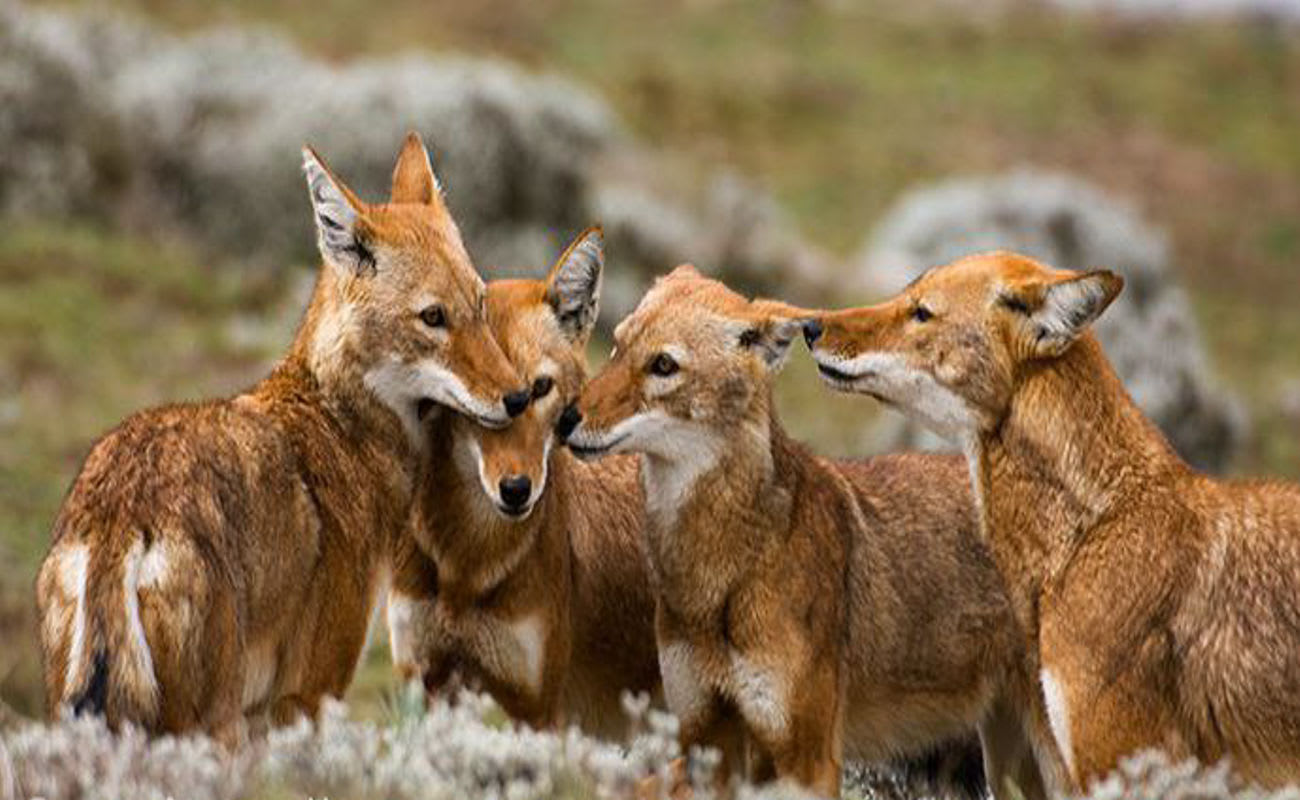
The country’s mountain ecosystems illustrate that connection clearly. The Ethiopian Wolf Conservation Programme describes the Ethiopian wolf as restricted to Ethiopia’s mountains, with approximately 500 animals surviving in small populations threatened by habitat loss and disease . Protecting the wolf therefore means protecting the high-altitude Afroalpine ecosystems and other endemic species associated with them, rather than focusing only on a single charismatic predator.
Land degradation creates another link between wildlife and rural livelihoods. Research supported through the National Academies’ Partnerships for Enhanced Engagement in Research programme documented severe gully erosion in the Blue Nile Basin. The project reported gullies as deep as 15 metres and found that they deliver much of the sediment to rivers while consuming grassland and cultivated land . Its findings argue for conservation measures that include community participation and attention to difficult restoration sites, including expanding gullies in bottomlands.
These pressures explain why Ethiopia’s conservation model increasingly involves several institutions at once. Government authorities provide mandates and public administration; research organisations contribute evidence; international agencies provide technical and financial support; and communities are essential to making land and wildlife protection workable over time.
The main threats to Ethiopia’s wildlife
Habitat loss and fragmentation
Habitat loss is a direct threat to Ethiopian wolves, whose remaining populations are small and isolated in mountain areas . More broadly, the GEF’s national project identifies species and habitat loss as a central conservation problem and links it to the need for improved landscape management and human–wildlife coexistence .
Land degradation can intensify this pressure. The Blue Nile Basin research found that erosion can remove productive grassland and farmland and transport large quantities of sediment into rivers . Conservation organisations therefore need to combine habitat protection with soil and water conservation, restoration and land-use planning.
Illegal wildlife trafficking and poaching pressure
The GEF project specifically identifies reduced illegal wildlife trafficking as one of its intended outcomes . The supplied research does not provide a current Ethiopia-wide poaching total, species-by-species seizure figure or verified annual arrest statistic, so responsible reporting should avoid presenting an invented national number.
Instead, the evidence points to the importance of coordinated enforcement and governance. EWCA, UNDP and EBI are named as executing and implementing partners in the GEF project, which is designed to reduce drivers of wildlife and habitat loss through integrated landscape conservation . Rangers and protected-area staff require clear mandates, suitable equipment, training, welfare support and accountability. WWF’s work through the Universal Ranger Support Alliance emphasises global standards for ranger capacity, employment, equality and conduct, while its ranger policy work also stresses responsible and accountable management .
Human–wildlife conflict
Human–wildlife coexistence is one of the explicit objectives of the GEF-supported project . That wording matters: conservation cannot be assessed only by the condition of wildlife populations if local people experience crop damage, livestock losses, restricted access to resources or unsafe encounters.
Effective partnerships should therefore identify conflict hotspots, involve affected communities in decisions and connect conservation benefits with local priorities. The research supplied here does not quantify conflict incidents in Ethiopia, nor does it establish that one intervention has solved the problem. Travellers should be cautious of claims that tourism alone eliminates conflict; the available evidence supports an integrated approach instead .
Climate change, drought and floods
Ethiopia’s Ministry of Finance describes recurrent droughts and floods as immediate challenges affecting livelihoods, food security and economic stability . These pressures can also alter water availability, vegetation and wildlife habitat. The Ethiopia–Norway forest and climate partnership is consequently linking forest stewardship, land restoration, participatory management and results-oriented climate finance .
Climate finance is not a substitute for wildlife management, but it can help address the landscape conditions on which wildlife depends. Its success will depend on transparent measurement, durable funding and meaningful participation by communities.
Key conservation organisations and partnerships
| Organisation or partnership | Role supported by the research |
|---|---|
| Ethiopian Wildlife Conservation Authority (EWCA) | Executing agency in the GEF integrated wildlife and landscape project; partner in the Ethiopian Wolf Conservation Programme |
| Ethiopian Biodiversity Institute (EBI) | Executing agency in the GEF project and institutional partner in the Payment for Ecosystem Services framework |
| Environmental Protection Authority (EPA) | Partner with IUCN, EBI and EWA in developing Ethiopia’s Payment for Ecosystem Services framework |
| Wildlife and conservation authorities | Public-sector partners responsible for translating national policy into landscape and protected-area action; specific mandates vary by programme |
| IUCN ESARO | Provided technical leadership and partnership support that helped catalyse the Payment for Ecosystem Services Proclamation |
| UNDP and the Global Environment Facility | UNDP is the implementing agency for the GEF-8 project; the GEF Trust Fund provides the project grant |
| Ethiopian Wolf Conservation Programme | Runs monitoring and research, One Health, biodiversity-friendly livelihoods and conservation translocation work in partnership with Dinkenesh Ethiopia, EWCA and regional governments |
| Ethiopia–Norway forest and climate partnership | Supports REDD+ investment, participatory forest management, restoration and forest finance planning |
IUCN, EPA, EBI and EWA: turning policy into finance
IUCN ESARO’s technical partnership with the EPA, EBI and the Ethiopian Wildlife Authority helped support the institutionalisation of Ethiopia’s Payment for Ecosystem Services framework . Parliament passed the Payment for Ecosystem Services Proclamation, which officially took effect in January 2026 .
Payment for Ecosystem Services, or PES, is intended to create a formal system that rewards people and institutions protecting important ecosystems. According to IUCN, the proclamation can unlock domestic funding streams for biodiversity and integrate ecological protection into national development planning .
The important point is not simply that a law was passed. PES must still be implemented fairly and transparently. Conservation organisations will need to clarify who qualifies for payments, how ecosystem benefits are measured, how funds reach local stewards and how safeguards prevent unequal outcomes. The research establishes the legal milestone, but it does not yet provide national programme results or verified payment outcomes .
GEF, UNDP, EWCA and EBI: integrated landscape conservation
The GEF project titled “Promoting Integrated Conservation of Wildlife and Landscapes for Sustainable Development of Ethiopia” was approved as a full-size GEF-8 project . Its stated objectives are to reduce species and habitat loss, improve human–wildlife coexistence, reduce illegal wildlife trafficking and strengthen landscape management for sustainable development .
UNDP is the implementing agency, while EWCA and EBI are listed as executing agencies . The project has a GEF grant of USD 11,932,415 and reported total co-financing of USD 59,675,417 . These are project-level financial figures, not a measure of all conservation spending in Ethiopia.
The Ethiopian Wolf Conservation Programme
The Ethiopian Wolf Conservation Programme is a specialist example of partnership-based conservation. Its current site describes a partnership involving WildCRU, Dinkenesh Ethiopia, EWCA and regional governments, under the aegis of the IUCN Species Survival Commission Canid Specialist Group; the programme is chiefly supported by the Wildlife Conservation Network .
Its listed activities include monitoring and research, One Health, biodiversity-friendly futures and conservation translocations . The One Health focus is particularly relevant to Ethiopian wolves because the programme identifies disease as one of the threats facing the species . Its work also demonstrates why species conservation cannot be separated from domestic animals, communities and the wider Afroalpine ecosystem.
Ethiopia and Norway: forests, restoration and climate finance
On 20 January 2026, Ethiopia’s Ministry of Finance described a joint consultation under the Ethiopia–Norway Partnership on Forest and Climate Change . The discussion reviewed progress under the 2024 partnership agreement and considered the future direction of the REDD+ Investment Program beyond June 2026 .
The next phase, described as REDD+ Investment Program III for 2026–2030, is expected to use blended finance and build on Norwegian support of USD 60 million, USD 40 million from the Green Legacy Initiative Special Fund and additional carried-forward resources . The ministry says the programme aims to deepen participatory forest management, strengthen institutional coordination, accelerate restoration, advance results-oriented forest finance and mobilise private investment .
For wildlife, the relevance is indirect but important: forest governance and restoration can improve habitat conditions while economic incentives may help reduce deforestation pressure. However, the source describes planned direction and financing, not completed wildlife-population results .
Results and setbacks: a balanced 2026 assessment
The clearest policy success is the Payment for Ecosystem Services Proclamation taking effect in January 2026 . It gives conservation finance a formal legal basis and reflects sustained collaboration between IUCN, EPA, EBI and EWA . The GEF project also represents a substantial attempt to connect biodiversity, climate change, land degradation, trafficking and human–wildlife coexistence within one national framework .
There are also practical research lessons. Community participation improved physical and biological conservation in the Blue Nile Basin gully-rehabilitation demonstration, while the nearby control area experienced severe gully expansion . This supports the value of locally engaged restoration, but the project also warned that government-led conservation mobilisation was not targeting some difficult gully hotspots .
The setbacks are equally important. The Ethiopian Wolf Conservation Programme reports that only about 500 Ethiopian wolves survive in small populations, with habitat loss and disease continuing to threaten them . The GEF project’s objectives show that illegal trafficking, habitat loss and conflict remain active conservation problems rather than resolved historical issues .
Funding continuity is another challenge. Mongabay reported on Ethiopia’s largest community conservation area seeking self-sufficiency after a USAID funding cut . That example illustrates the vulnerability of conservation models that depend heavily on external grants, although the supplied source does not provide enough detail to evaluate the area’s long-term ecological results.
Finally, new finance requires accountability. WWF’s international ranger work stresses adequate resources, professional standards and a code of conduct developed with the United Nations Office of the High Commissioner for Human Rights . Ethiopia’s conservation partnerships should be judged not only by money raised or patrol activity, but also by ecological outcomes, community rights, safety, transparency and the quality of local employment.
Community conservation and responsible tourism
Communities are not simply beneficiaries of conservation projects. They are land users, local observers, livestock owners, farmers and potential stewards. The Blue Nile Basin research explicitly demonstrated the value of farmer participation in soil and water conservation . The Ethiopia–Norway partnership likewise places participatory forest management and community involvement at the centre of its approach .
Tourism can support this system when money reaches legitimate local and conservation partners. A wildlife safari, mountain visit or cultural journey can create demand for guides, accommodation, transport and protected-area services. Yet the supplied research does not establish a national percentage of safari revenue returned to conservation, so travellers should ask operators exactly where park fees, community levies and donations go.
SafariFind travellers can book conservation-supporting safaris on SafariFind, but the responsible choice is to verify the operator’s claims rather than assume that every wildlife safari or wildlife safari park visit automatically funds protection. Ask whether the company works with licensed authorities, employs local guides, follows wildlife-viewing rules and publishes information about community or conservation contributions.
Visitors should also understand that conservation areas are living landscapes, not just photographic backdrops. Respect local rules, avoid pressuring guides to approach animals, do not buy wildlife products and choose accommodation that can explain its water, waste and community policies. These actions complement, but do not replace, the work of EWCA, regional authorities, community organisations and specialist conservation programmes.
How travellers can help responsibly
- Choose transparent operators: Ask for named local partners, licensing information and a clear explanation of conservation or community payments.
- Support credible programmes: Where appropriate, donate directly to established initiatives such as the Ethiopian Wolf Conservation Programme, which identifies its institutional and regional-government partners publicly .
- Respect wildlife and communities: Follow guide instructions, keep a safe distance and never request behaviours that disturb animals.
- Avoid wildlife trafficking: Do not purchase animal parts or products whose origin cannot be demonstrated as legal and ethical. Reducing illegal wildlife trafficking is an explicit national conservation objective .
- Value local expertise: Use locally based guides and services where possible, and treat community knowledge as part of the conservation system rather than an optional add-on.
- Check current conditions: Conservation, access and travel information can change. Use current advice from authorities and operators, especially when visiting remote landscapes.
Conclusion
Ethiopia’s wildlife protection effort in 2026 is being shaped by institutions rather than one organisation acting alone. EWCA, EBI, EPA, IUCN, UNDP, the GEF, the Ethiopian Wolf Conservation Programme, regional governments and the Ethiopia–Norway partnership each contribute different capabilities, from policy and research to landscape finance and species monitoring .
The new PES law is a meaningful foundation, and the integrated GEF project offers a framework for tackling trafficking, habitat loss, conflict and landscape degradation together . But the continued vulnerability of Ethiopian wolves, erosion pressures, climate shocks and funding uncertainty show why implementation matters more than announcements . The strongest conservation partnerships will be those that produce measurable ecological gains, protect community interests and remain financially and institutionally durable.
Frequently Asked Questions
Which organisations protect Ethiopia’s wildlife?
Key organisations named in the research include the Ethiopian Wildlife Conservation Authority, Ethiopian Biodiversity Institute, Environmental Protection Authority, IUCN, UNDP, the Global Environment Facility and the Ethiopian Wolf Conservation Programme. Their work covers policy, landscape management, conservation finance, research, species monitoring and human–wildlife coexistence .
What is Ethiopia’s most important conservation development in 2026?
The Payment for Ecosystem Services Proclamation took effect in January 2026. It creates a legal framework for rewarding ecosystem protection and aims to unlock domestic biodiversity finance .
How many Ethiopian wolves are left?
The Ethiopian Wolf Conservation Programme states that approximately 500 Ethiopian wolves survive in small mountain populations. Habitat loss and disease remain threats .
What does the GEF wildlife project in Ethiopia do?
The GEF-supported project aims to reduce species and habitat loss, improve human–wildlife coexistence, reduce illegal wildlife trafficking and strengthen landscape management for sustainable development. UNDP is the implementing agency, with EWCA and EBI as executing agencies .
Why is community participation important in Ethiopian conservation?
Communities use and manage many landscapes where conservation takes place. Research in the Blue Nile Basin found improvement in gully rehabilitation through community participation, while erosion expanded severely in the control area .
How is climate change affecting conservation in Ethiopia?
Ethiopia’s Ministry of Finance identifies recurrent droughts and floods as challenges affecting livelihoods, food security and economic stability. The Ethiopia–Norway partnership responds through participatory forest management, restoration and climate finance planning .
Does tourism fund wildlife conservation in Ethiopia?
Tourism can support conservation and local economies, but the supplied research does not establish a national share of safari revenue returned to conservation. Travellers should ask operators how fees and contributions are distributed.
What should a responsible wildlife safari visitor do in Ethiopia?
Choose transparent operators, follow wildlife-viewing rules, use local services, avoid wildlife products and ask for evidence of conservation or community partnerships. Do not assume that every wildlife safari automatically funds protection.
Why Trekking in the Simien Mountains of Ethiopia is Bucket List Worthy
The supplied research does not provide enough current information to assess this trek or make a safety claim. Travellers should consult current official travel advice and local operators before planning a Simien Mountains visit.
Alternative treks in Ethiopia due to Simien Mountains safety concerns?
The supplied research does not compare Ethiopian trekking routes or provide current safety conditions. Choose alternatives only after checking current official advice, local access conditions and guidance from reputable operators.
V2Ui.sources
- Policy in action: How IUCN ESARO’s technical leadership catalyzed the institutionalization of Ethiopia’s PES framework
- Community Conservation Resilience Initiative in Ethiopia
- Project 1-289 Ethiopia
- Promoting Integrated Conservation of Wildlife and Landscapes for Sustainable Development of Ethiopia
- Where We Work
- After USAID cut, Ethiopia’s largest community conservation area aims for self-sufficiency
- Ethiopia and Norway Collaborate to Advance Forest and Climate Finance(official)
- Conservation Finance Program(official)
- Financial Assistance(official)
- The Ranger Fund
- Ethiopian Wolf Conservation Programme
- The Importance of Rangers to Conservation
Related to
Ready to start your safari adventure?
Explore curated safari packages and find your perfect African adventure with verified operators.