Rothschild Giraffe Conservation in Uganda (2026): Status and Action
Uganda is the global stronghold for the Rothschild giraffe, now commonly treated in conservation research as the Nubian giraffe. More than 2,400 Nubian giraffes are estimated in Uganda, but poaching, habitat pressure, human–wildlife conflict and oil development remain ongoing concerns [12].

Quick answer: Uganda is the most important remaining stronghold for the Rothschild giraffe, a name still widely used for the population now treated by conservation organisations as the Nubian giraffe. The Giraffe Conservation Foundation (GCF) and Uganda Wildlife Authority (UWA) estimate that Uganda’s Nubian giraffe population has recovered to more than 2,400 individuals, with about 2,250 in Murchison Falls National Park . That recovery is significant, but the population remains vulnerable because it is concentrated in a small number of protected areas and faces poaching, habitat loss, human–wildlife conflict and oil-development risks .
Last reviewed August 2026. Conservation data changes — see the cited sources for the latest figures.
Why Rothschild giraffe conservation matters in Uganda
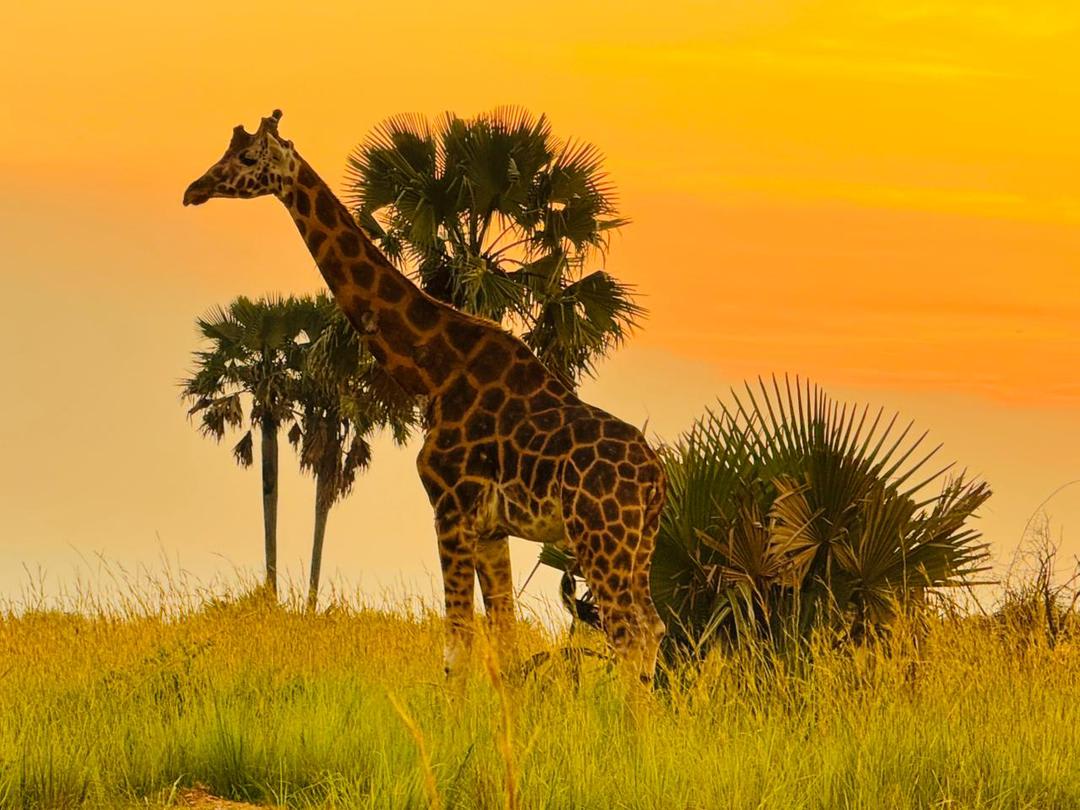
Rothschild’s giraffe (Giraffa camelopardalis rothschildi) is recognised by its pale background coat, large irregular markings and conspicuously white lower legs. The name remains familiar to safari travellers, while current conservation work in Uganda generally refers to these animals as Nubian giraffes. GCF describes the remaining Ugandan population as Nubian giraffe and notes that the animals were previously known as Rothschild’s giraffe .
This naming change reflects a broader shift in giraffe taxonomy. Genetic research supported by GCF has identified four giraffe species rather than treating all giraffes as one species, and some conservation sources now combine Rothschild’s populations within the Nubian giraffe total . For clarity, this article uses “Rothschild giraffe” when discussing the familiar Ugandan conservation subject, and “Nubian giraffe” when reporting the population estimates used by the cited programmes.
Uganda’s importance is geographic as well as numerical. The historical range of the Nubian giraffe extended across Uganda, Kenya, South Sudan and Ethiopia, but only small and isolated populations remain across much of that former range . The Federal Register’s review reports that Nubian giraffe numbers in Uganda declined by as much as 90% from the 1960s, largely in connection with poaching and political and social instability across their historical range .
Today, northern Uganda provides the principal refuge. Murchison Falls National Park contains the largest wild population of Nubian giraffes, while Kidepo Valley National Park retains another important population . Protecting these giraffes therefore supports more than one distinctive animal: it helps preserve a northern savanna ecosystem where giraffe browse woody vegetation and share habitat with other large mammals.
Rothschild giraffe population in Uganda: what the numbers mean
Published estimates differ because they refer to different years, taxonomic treatments and survey methods. The most useful way to interpret them is as evidence of a strong recovery from a very low baseline, rather than as a single permanently fixed total.
| Measure | Reported figure | Source and context |
|---|---|---|
| Uganda population in 2010 | Fewer than 300 | GCF describes two precariously small populations in Murchison Falls and Kidepo Valley National Parks |
| Murchison Falls population | Approximately 2,250 | GCF estimate for the park’s principal population ; the Federal Register reports the same figure |
| Uganda population in the latest GCF programme summary | More than 2,400 | GCF estimate following long-term work with UWA |
| Total Nubian giraffe population | Approximately 3,022 | Federal Register assessment citing Brown et al. (2021) |
The figures show why Uganda is central to the subspecies’ future. The Federal Register estimates that Murchison Falls holds about 60% of the total Nubian giraffe population . At the same time, a population concentrated in one major stronghold is exposed to local shocks. A disease event, security breakdown, habitat conversion or poorly managed infrastructure project could affect a large share of the animals at once.
There is also an important distinction between population growth and secure conservation status. GCF reports that numbers have increased and available habitat has expanded, but it also stresses that continuous monitoring remains essential . Recovery does not remove the need for protection, ecological research and effective management.
The main threats to Rothschild giraffes in Uganda
Poaching and snares
Illegal hunting was a major historical driver of the Nubian giraffe’s decline in Uganda and across its former range . In Murchison Falls, GCF identifies poaching, particularly the use of snares, as one of the park’s major current threats . Snares set for other wildlife can injure or kill giraffes even when giraffes are not the intended target .
Poaching pressure is shaped by wider conditions, including insecurity, poverty and reduced access to legitimate livelihoods. The conservation response therefore requires more than occasional patrols. It depends on trained rangers, intelligence, veterinary support, law enforcement and cooperation with communities living around protected areas.
Habitat loss and fragmentation
Giraffes depend on woodland, shrubland and savanna with sufficient browse. Across Africa, habitat loss driven by deforestation, land-use conversion and human population growth is a principal threat to giraffes, while illegal hunting for meat and hide adds direct pressure . In Uganda, the same pressures can reduce feeding areas, narrow movement routes and bring giraffes into closer contact with farms and livestock.
Fragmentation is especially concerning when a population is already concentrated in a few parks. Giraffes need access to seasonal resources and safe movement routes; a park boundary cannot by itself protect every ecological connection beyond the reserve. Conservation planning must therefore consider the wider landscape around Murchison Falls and other protected areas, not only the animals visible on a game drive.
Human–wildlife conflict
Giraffes and people may compete for the same water, vegetation and land. The Federal Register identifies human–wildlife conflict as a consequence of people and wildlife sharing natural resources in Uganda . As agricultural activity expands near protected areas, giraffes can damage crops or be exposed to retaliation, while communities can face real costs from living beside wildlife.
Conflict mitigation is therefore a conservation priority as well as a social responsibility. Measures should be based on local evidence, involve affected communities and reduce both giraffe mortality and the financial burden on households. Uganda’s wider conservation picture is explored in SafariFind’s guide to human–wildlife conflict in Uganda.
Oil development and infrastructure
Oil extraction is identified by GCF as a major threat in Murchison Falls National Park alongside poaching . Development can bring roads, traffic, noise, construction and habitat disturbance. The risk is not limited to a single project: cumulative effects may alter how giraffes move, feed and use habitat.
Conservation organisations have highlighted the need for environmental studies, guidelines for oil companies and additional ranger capacity in Murchison Falls . The practical test is whether development is subject to strong safeguards, transparent monitoring and enforceable limits. A recovery in giraffe numbers should not be treated as evidence that all future development impacts are acceptable.
Climate and ecological change
The supplied Ugandan programme sources do not provide a specific climate-related population figure for Rothschild giraffes. Climate change can nevertheless interact with the documented pressures on giraffe habitat by influencing rainfall, water availability, vegetation and fire regimes. For that reason, long-term monitoring should track habitat condition and seasonal movements as well as counting giraffes. This is an area where more Uganda-specific published evidence would improve conservation decisions.
What is being done to conserve giraffes in Uganda?
Operation Twiga and strategic translocations
Operation Twiga is a partnership between UWA and GCF that moves giraffes to safer or historically occupied habitat to establish additional populations . In 2016–17, Operation Twiga I and II moved 37 Nubian giraffes across the Nile to the southern bank of Murchison Falls National Park . The purpose was to avoid keeping the population on only one side of the river, particularly as the northern sector faced poaching and anticipated oil-development pressure .
Translocation is not a shortcut. It requires veterinary preparation, capture expertise, transport planning, suitable release habitat and post-release monitoring. GCF’s Uganda programme describes training for Ugandan wildlife veterinarians, rangers and the national game-capture team, helping build local capacity rather than relying solely on international specialists . SafariFind’s overview of wildlife translocations and rewilding in Uganda places this approach in the wider national conservation context.
Protected-area management and anti-poaching
UWA is the national wildlife authority working with GCF on giraffe conservation in Uganda . Their collaboration includes monitoring, anti-poaching efforts, technical assistance and support for local veterinary and capture teams . These functions are part of the wider job of protecting Uganda’s national parks, where ranger operations must address threats to many species at once.
Effective protection includes removing snares, patrolling high-risk areas, responding to wildlife emergencies and maintaining reliable information on population distribution. It also depends on the safety and training of the people doing the work. Visitors can learn more about the broader management context in Protecting Uganda’s national parks.
Monitoring and science
GCF describes Uganda’s giraffe programme as science-based and emphasises continued monitoring of the recovering population . Monitoring can reveal whether translocated animals survive, reproduce, establish stable home ranges and interact safely with the existing population. It can also identify emerging threats before they become population-wide crises.
For a species with small and isolated populations, consistent methods matter. Estimates should be compared carefully across years, especially when the name “Rothschild giraffe” is being used alongside “Nubian giraffe” and when assessments apply different taxonomic frameworks.
Community and tourism’s role
Responsible tourism can help make protected-area conservation financially and politically durable. Tusk reports that its support for the Uganda Conservation Foundation contributes to habitat restoration and wildlife protection in Murchison Falls, a stronghold for Nubian giraffes . Tourism also creates incentives for parks, operators and communities to maintain wildlife habitat, although the benefits must reach local people and should not be assumed automatically.
A wildlife safari in Murchison Falls can help visitors understand giraffe conservation in the landscape where much of the population lives. A responsible operator should explain how park fees, conservation partnerships and local employment contribute to protection, without promising that every payment directly funds giraffe projects. Travellers can book conservation-supporting safaris on SafariFind and ask operators for clear information about their community and conservation commitments.
Tourism is not risk-free. Vehicle crowding, off-road driving, careless waste, excessive noise and poor wildlife etiquette can reduce the quality of the habitat experience. Visitors should follow UWA rules, keep a respectful distance, remain in designated areas and never encourage a driver to chase or surround giraffes.
Results and remaining challenges
The strongest documented result is the increase from fewer than 300 Nubian giraffes in Uganda in 2010 to more than 2,400 in the latest GCF programme estimate . The 37-giraffe translocation across the Nile in 2016–17 also created a separate population area within Murchison Falls . These outcomes demonstrate the value of combining protected-area management, translocation, veterinary expertise, ranger training and international technical support.
However, the recovery has not ended the conservation problem. Murchison Falls still contains most of Uganda’s giraffes and about 60% of the wider Nubian population according to the Federal Register assessment . GCF continues to identify poaching and oil extraction as major threats, and it says ongoing monitoring is crucial . Habitat loss, human–wildlife conflict and the challenge of managing development around protected areas also remain unresolved pressures .
The appropriate conclusion is cautious optimism. Uganda has shown that a heavily reduced giraffe population can recover when institutions and conservation partners work together. The next test is whether that recovery can be spread across secure habitat, supported by communities and maintained under changing economic, climatic and land-use conditions.
How travellers can help responsibly
- Choose a licensed operator that follows UWA park rules and can explain its approach to community benefits and conservation funding.
- Stay on authorised roads and follow guide instructions around giraffes and other wildlife.
- Do not feed, call to, chase or crowd giraffes for photographs.
- Support accommodation and guides that employ local people and demonstrate long-term links with nearby communities.
- Prefer conservation organisations that publish programme information, explain how funds are used and distinguish verified results from aspirations.
- Share accurate information: Uganda’s giraffe recovery is important, but the population remains exposed to concentrated threats and needs continued protection.
Rothschild giraffe conservation in Uganda is ultimately a long-term partnership between UWA, GCF, park staff, communities, researchers, responsible tourism businesses and visitors. The giraffes’ future will depend not only on moving animals to safer places, but on keeping those places safe.
Frequently Asked Questions
What is the conservation status of Rothschild giraffes in Uganda in 2026?
Uganda’s Rothschild giraffes, generally treated in current conservation work as Nubian giraffes, remain conservation-dependent despite a major recovery. GCF estimates more than 2,400 Nubian giraffes in Uganda, while the Federal Register identifies poaching, human–wildlife conflict and habitat pressure as continuing concerns .
How many Rothschild giraffes are left in Uganda?
The latest GCF programme summary estimates that Uganda has more than 2,400 Nubian giraffes, the population commonly associated with Rothschild’s giraffe in Uganda . Estimates vary by date, survey method and taxonomy.
Where can I see Rothschild giraffes in Uganda?
Murchison Falls National Park is Uganda’s main stronghold and has an estimated 2,250 Nubian giraffes. Kidepo Valley National Park also retains a population .
Why is Murchison Falls National Park important for giraffe conservation?
Murchison Falls contains Uganda’s largest Nubian giraffe population, estimated at about 2,250 animals, and approximately 60% of the wider Nubian giraffe population according to the Federal Register assessment .
What is Operation Twiga?
Operation Twiga is a partnership between UWA and GCF that translocates giraffes to safer or historically occupied habitat. In 2016–17, its first two operations moved 37 Nubian giraffes across the Nile to Murchison Falls’ southern bank .
What are the biggest threats to Rothschild giraffes in Uganda?
The main documented threats are poaching, especially snares, habitat loss and fragmentation, human–wildlife conflict and oil extraction in Murchison Falls National Park .
Are Rothschild giraffes and Nubian giraffes the same?
Conservation organisations increasingly use Nubian giraffe for the population historically called Rothschild’s giraffe in Uganda. GCF’s Uganda programme explicitly notes that Nubian giraffes were previously known as Rothschild’s giraffes .
How does tourism help giraffe conservation in Uganda?
Responsible tourism supports protected-area economies and can contribute to conservation partnerships, habitat protection and local employment. Tusk reports support for habitat and wildlife restoration work in Murchison Falls through the Uganda Conservation Foundation .
How can visitors protect giraffes on safari?
Visitors should follow UWA rules, stay on authorised roads, keep a respectful distance, avoid feeding or chasing giraffes, and choose operators that can explain their community and conservation commitments.
Has Uganda’s giraffe population recovered?
Yes, the population has increased substantially from fewer than 300 Nubian giraffes reported in Uganda in 2010 to more than 2,400 in the latest GCF estimate . Recovery is not the same as security because most animals remain concentrated in Murchison Falls and major threats continue .
V2Ui.sources
- Federal Register: Endangered and Threatened Wildlife and Plants; Listing the Giraffe(official)
- Nubian Giraffe Conservation in Uganda - Giraffe Conservation Foundation
- Giraffe - Tusk
- Giraffe Conservation - Cheyenne Mountain Zoo
- To Save These Rare Giraffes, Uganda Built an Ark (of Sorts)
- Giraffe Conservation Foundation
Related to
Ready to start your safari adventure?
Explore curated safari packages and find your perfect African adventure with verified operators.