Vulture Conservation in Ethiopia (2026): Status and Action
Ethiopia remains a major stronghold for Africa’s threatened vultures, but poisoning, habitat change, unsafe food sources and weak mortality reporting continue to undermine populations. Conservation priorities include ranger training, coordinated monitoring, anti-poisoning action and protection of highland and Afar habitats.

Quick answer: Ethiopia is a stronghold for African vultures, supporting important highland habitat for Bearded, Hooded, Rüppell’s and White-backed vultures and lowland habitat for Egyptian Vultures. However, only about one-fifth of identified vulture priority areas in the country are protected, while poisoning, habitat degradation, human disturbance and limited monitoring remain serious conservation challenges .
Conservation work is under way. The Ethiopian Wildlife and Natural History Society (EWNHS), BirdLife International and park-management partners have trained rangers, while researchers and local organisations are improving population surveys, mortality databases and public awareness. The evidence points to progress in capacity and knowledge—not yet a completed recovery story .
Last reviewed August 2026. Conservation data changes — see the cited sources for the latest figures.
Why vulture conservation matters in Ethiopia
Vultures are specialised scavengers that remove animal carcasses rapidly. This ecological service matters in landscapes where livestock, wildlife and people share grazing areas, roads, slaughter facilities and protected habitats. The Peregrine Fund describes the White-backed Vulture as capable of helping a large group of vultures strip a carcass efficiently, while research in Addis Ababa links declining vulture numbers with increasing feral-dog numbers around abattoirs .
That relationship has implications beyond biodiversity. Addis Ababa’s abattoirs provide discarded animal parts for scavengers, creating a food source for vultures but also a food subsidy for feral dogs when fencing fails. A five-year study using time-lapse cameras and in-person surveys found that vulture numbers at the study sites roughly halved while feral-dog numbers more than doubled. Feral dogs are a major rabies vector, so the researchers identified improved abattoir fencing as a possible intervention with both conservation and public-health benefits .
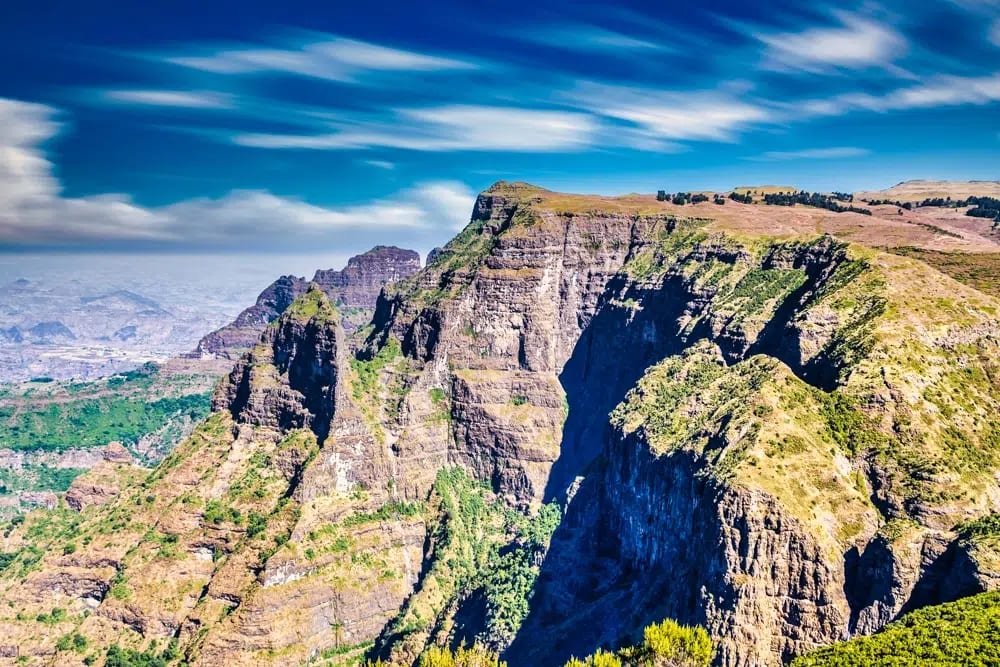
Ethiopia is also important because several threatened species use different parts of the country. Distribution modelling identified the Ethiopian highlands as particularly important for Bearded, Hooded, Rüppell’s and White-backed vultures. The lowlands of north-eastern Ethiopia were especially valuable for Egyptian Vultures, and Ethiopia has probably hosted eastern Africa’s largest congregation of wintering Egyptian Vultures, with more than 1,000 individuals recorded annually in earlier research; that study also reported a decline over the preceding five years .
Which vulture species occur in Ethiopia?
The national picture includes resident and migratory species, with conservation needs that differ by habitat and behaviour. The available Ethiopian distribution modelling produced robust models for five species: three classified as Critically Endangered, one Endangered and one Near Threatened . The most conservation-relevant species identified in the research are:
| Species | Scientific name | Role in Ethiopia’s conservation picture |
|---|---|---|
| White-backed Vulture | Gyps africanus | A Critically Endangered African vulture found across parts of Ethiopia; highland areas are among its identified priority habitats . |
| Rüppell’s Vulture | Gyps rueppelli | A Critically Endangered species for which Ethiopia’s highlands are identified as particularly important . |
| Hooded Vulture | Necrosyrtes monachus | A Critically Endangered species included among the highland conservation priorities . |
| Egyptian Vulture | Neophron percnopterus | A migratory species for which north-eastern lowlands, including the Afar region, are particularly valuable . |
| Bearded Vulture | Gypaetus barbatus | A highland priority species in Ethiopia’s distribution models . |
The table should not be read as a complete national checklist or as a current population census. Ethiopia-wide population totals were not provided in the supplied research, so a responsible 2026 assessment should focus on documented distribution, site-level counts and trends rather than inventing a single national number.
The main threats to vultures in Ethiopia
Poisoning and unsafe carcasses
Poisoning is one of the most important threats to African vultures. Poison may be placed on livestock carcasses to kill predators, or used in attempts to control feral dogs and other problem animals. Scavengers cannot distinguish a poisoned carcass from a safe one, so a single event can affect several species and other wildlife at the same time .
The African-Eurasian Vulture Multi-species Action Plan records that poisons used for feral-dog control in Ethiopia have killed two vulture species. It also identifies poisoning linked to problem-animal control as a threat to wintering Egyptian Vultures . A systematic review recommends poisoning-hotspot surveillance, rapid reporting, veterinary and forensic protocols, safe disposal of contaminated carcasses, population monitoring and coordinated databases involving Ethiopia and other African range states .
Poisoning is not simply a wildlife-management problem. It can reflect livestock losses, fear of predators, poorly controlled chemicals and gaps in local response capacity. Effective conservation therefore needs rapid-response training and practical alternatives for livestock owners, alongside investigation and enforcement where poisoning is deliberate.
Habitat loss and degradation
Vultures range widely while searching for carcasses, roosting sites and breeding habitat. Distribution modelling in Ethiopia found that protection is uneven: about one-third of the Egyptian Vulture’s core distribution was protected, compared with one-sixth of the White-backed Vulture’s, while the other modelled species had roughly one-tenth of their priority areas protected. Overall, only about one-fifth of vulture priority areas were protected .
This matters because a national park cannot protect a bird that regularly travels beyond its boundaries. The modelling study argues that broad spatial and legislative measures are needed, rather than relying only on isolated protected areas . Habitat degradation can also reduce the availability of safe roosts, nesting locations and naturally available food, although the supplied research does not quantify the area lost in Ethiopia.
Urban and abattoir pressures
Abattoirs can function as dependable feeding sites, but they may also expose vultures to contaminated food, disturbance, conflict with people and competition with feral dogs. The Addis Ababa study found that repairing abattoir fences could help maintain a safer food source for critically endangered vultures while reducing access for feral dogs . This is a useful example of targeted urban conservation: the intervention is not a substitute for protecting wild habitat, but it could address two connected problems at once.
Human disturbance, infrastructure and climate-related uncertainty
The Ethiopian research supplied for this article identifies habitat pressures and human disturbance among the threats requiring attention. The Vulture Multi-species Action Plan also lists human disturbance and habitat degradation as threats to Egyptian Vultures . The sources do not provide a national figure for climate-driven vulture decline, collision mortality or power-line deaths in Ethiopia. Those issues should therefore be investigated through monitoring rather than presented as quantified national trends.
Climate variability may alter livestock movements, carcass availability and the condition of dryland habitats, but the supplied evidence does not establish the scale of those effects in Ethiopia. Conservation planning should treat this as a research and resilience priority, not as a proven national population statistic.
What is being done to protect vultures?
Ranger training in Awash National Park
BirdLife International reported ranger training in Awash National Park, where Dr Bruktawit Abdu worked with park rangers on vulture identification and data collection. Ranger Edris Abdella described the practical value of learning to identify the country’s vulture species and record information that can support conservation .
EWNHS has also committed to working with Ethiopian park-management services and external partners to establish a regional database of vulture mortality. Better mortality records can reveal where poisoning and other causes are concentrated, allowing scarce conservation resources to be directed more effectively .
Surveys, modelling and local research
Research capacity is expanding, but the evidence base remains uneven. A 2026 study of Critically Endangered White-backed Vultures reported 1,150 sightings in its study area, of which 79.5% were adults; the abstract identifies habitat-related threats but does not provide a national population estimate . This illustrates why site-specific counts should not be converted into a countrywide total.
The Peregrine Fund’s Africa programme combined road surveys, GPS-tracking and eBird citizen-science records to model vulture occurrence across Ethiopia. The resulting maps identified highland and north-eastern lowland priorities and showed that protection is incomplete . Such work can guide future surveys, identify potential safe zones and help compare changes between regions over time.
In 2025, the March Conservation Fund supported a project led by Amleset Gaim Kinfe to study the population status, threats and conservation awareness of White-backed Vultures in Tigray. The grant listing demonstrates investment in locally led research, but it does not yet report the project’s results .
Awareness and coordinated anti-poisoning action
BirdLife and partner organisations have supported awareness programmes in Ethiopia that explain vultures’ ecological value and the need for their conservation . The systematic review recommends combining awareness with mortality reporting, poison-hotspot surveillance, rapid response, legal enforcement, forensic protocols and transboundary coordination through the African Wildlife Poison Database .
These actions complement the broader work of Ethiopian conservation organisations. SafariFind’s guide to conservation organisations protecting Ethiopia’s wildlife provides wider context on the institutions and partnerships working across the country’s biodiversity landscape.
Results and setbacks: what does the evidence show?
The clearest progress is in knowledge-building and conservation capacity. Rangers have received species-identification and data-collection training; mortality-database development has been proposed; national-scale distribution models have identified priority landscapes; and locally led White-backed Vulture research has received support . These are important foundations for measurable recovery.
The setbacks are equally clear. The available research reports declining Egyptian Vulture numbers at an important wintering congregation, incomplete protection of priority areas, and a sharp contrast between vultures and feral dogs at Addis Ababa abattoirs . A systematic review also warns that conservation recommendations often fail to receive adequate implementation because of environmental, socioeconomic, legal, technical, staffing and funding constraints .
There is no sound basis in the supplied sources for claiming that Ethiopian vulture populations have recovered, that poisoning has been eliminated or that all priority habitat is secure. The most defensible conclusion for 2026 is that Ethiopia remains nationally important for vultures, while recovery depends on turning surveys and training into sustained prevention, enforcement and habitat protection.
Community and tourism’s role
Vulture conservation is strongest when it addresses the needs of people who live with livestock, predators, slaughter facilities and protected areas. Anti-poisoning work should listen to livestock owners and pastoralists, explain the consequences of contaminated carcasses and provide practical responses to predator losses. In urban areas, better-managed abattoils can protect scavengers while reducing feral-dog access, as the Addis Ababa study proposes .
Tourism can support this work when visitor spending reaches responsible park management, local guides, community enterprises and conservation organisations. Birdwatchers and safari guests can contribute useful observations when records are submitted through appropriate citizen-science channels; the Ethiopian distribution study used eBird data alongside road surveys and GPS tracking . Tourism is not automatically conservation-positive, however. Visitors should avoid disturbing roosts or nesting birds, never approach feeding sites and choose operators that explain how conservation fees and community benefits are used.
Travellers can book conservation-supporting safaris on SafariFind, while recognising that a booking is only one part of a wider system involving parks, researchers, communities and public authorities.
How travellers can help responsibly
- Keep distance from vultures. Do not flush birds from roosts, nests or carcasses, and follow park-ranger instructions.
- Choose transparent operators. Ask whether an itinerary supports local guides, protected-area management or a named conservation programme.
- Report observations carefully. Submit photographs and locations through established platforms or directly to conservation researchers; do not publicise sensitive nest locations.
- Do not handle wildlife. A sick, injured or grounded vulture should be reported to park staff or an appropriate wildlife authority.
- Support evidence-led organisations. Prioritise groups that publish their objectives, methods and results rather than relying only on dramatic claims.
- Learn the local context. Vulture decline can be connected to livestock protection, feral-dog management, food waste and land-use decisions, so conservation solutions need community participation.
What should happen next?
Five priorities emerge from the research:
- Expand mortality reporting beyond individual parks and make records usable for rapid response .
- Strengthen anti-poisoning training, investigation, forensic sampling and safe carcass-disposal protocols .
- Protect the highland and north-eastern lowland areas identified as vulture priorities, including habitat outside formal protected areas .
- Test practical interventions at abattoirs, particularly fence repair and measures that reduce feral-dog access .
- Continue Ethiopian-led surveys and awareness work so that conservation decisions are based on current, site-specific evidence .
Ethiopia’s vultures provide a visible test of whether conservation can connect protected areas, working landscapes, cities and communities. The country retains internationally important vulture habitat, but the next step is sustained implementation: preventing poisoning, improving data, securing flight and feeding landscapes, and measuring whether local actions produce healthier populations.
Frequently Asked Questions
What is the conservation status of vultures in Ethiopia in 2026?
Vultures in Ethiopia face serious conservation pressure, although the country remains a major African stronghold. The Ethiopian priority-species group includes three Critically Endangered species, one Endangered species and one Near Threatened species; only about one-fifth of identified vulture priority areas were protected in the cited distribution study .
Which vulture species are found in Ethiopia?
The research identifies Bearded, Hooded, Rüppell’s, White-backed and Egyptian vultures as key species in Ethiopia’s conservation planning. Highland areas are especially important for the first four, while north-eastern lowlands are particularly valuable for Egyptian Vultures .
What is the biggest threat to vultures in Ethiopia?
Poisoning is one of the most serious threats. Poisons used to control predators or feral dogs can contaminate carcasses and kill vultures and other scavengers .
Are Egyptian Vultures declining in Ethiopia?
Earlier research recorded more than 1,000 wintering Egyptian Vultures annually in Ethiopia and reported a decline in those numbers over the preceding five years. The supplied research does not provide a newer national estimate for 2026 .
Why are abattoirs important for vultures in Addis Ababa?
Abattoirs can provide discarded animal parts as a food source for vultures. However, damaged fencing can also provide food for feral dogs; a five-year Addis Ababa study found that vulture numbers roughly halved while feral-dog numbers more than doubled at its study sites .
What is being done to conserve vultures in Ethiopia?
Actions include ranger training in Awash National Park, development of a regional vulture-mortality database, national distribution modelling, public-awareness programmes and locally led White-backed Vulture research in Tigray .
How can tourists help vulture conservation in Ethiopia?
Tourists can use responsible operators, support protected-area and community initiatives, submit suitable sightings through established citizen-science channels and avoid disturbing roosting, nesting or feeding birds. The Ethiopian modelling work used eBird data alongside scientific surveys .
Does Ethiopia have enough protected habitat for vultures?
No. The cited modelling study found that overall only about one-fifth of vulture priority areas were protected, with protection varying substantially by species . Because vultures range widely, conservation also needs measures outside formal protected areas.
What should I do if I see a dead or poisoned vulture?
Do not touch the bird or carcass. Move away, keep people and domestic animals clear, record the location if it is safe and report it promptly to park staff or the relevant wildlife authority so trained personnel can follow appropriate sampling and disposal procedures .
Have vultures recovered in Ethiopia?
The supplied evidence does not demonstrate a national recovery. It shows progress in ranger training, research and planning, but also declining Egyptian Vulture numbers at an important congregation, incomplete habitat protection and continuing poisoning and implementation challenges .
V2Ui.sources
- Population Status and Habitat Preferences of the Critically Endangered White-backed Vulture in Ethiopia(official)
- Abundance, distribution, and conservation status of critically endangered vultures in N’Djamena and environs, Chad, Central Africa
- Empowering Park Rangers to Support Vulture Conservation in Ethiopia
- White-backed Vulture
- White-backed Vulture Gyps africanus Species Factsheet
- As vulture numbers decline, feral dog numbers grow, posing risk to ecosystem and human health, new study finds
- WCC 2016 Res 022 - Activity Report
- Vulture poisoning in Sub-Saharan Africa and its implications for conservation planning: A systematic review(official)
- Multi-species Action Plan to Conserve African-Eurasian Vultures
- Impact Report 2025
- Africa Program Team: Spatial priorities for vulture conservation in Ethiopia
- Report of 10th Annual Meeting of Saving Asia’s Vultures from Extinction
Related to
Ready to start your safari adventure?
Explore curated safari packages and find your perfect African adventure with verified operators.